


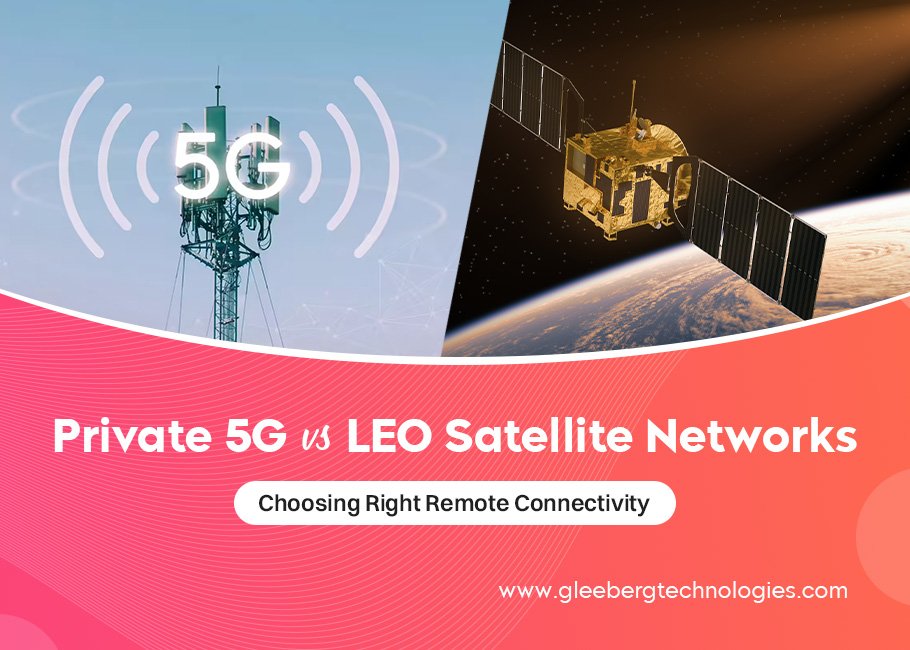
Private 5G vs. LEO Satellite Networks Choosing Right Remote Connectivity
For modern manufacturing, “remote” no longer means “disconnected.” From high-altitude mining sites to offshore production platforms, the demand for high-performance industrial connectivity is surging.
As Industry 4.0 matures, two titans have emerged to solve the rural reach problem: Private 5G and LEO (Low Earth Orbit) Satellite Networks.
But choosing between them isn’t just a technical box to check. It’s a strategic decision that dictates your site’s automation ceiling.
Private 5G
When precision is non-negotiable, Private 5G networks are the gold standard. Unlike public cellular, a private network gives a manufacturer total sovereignty over their spectrum and security.
If your site relies on Autonomous Mobile Robots (AMRs) or real-time Digital Twins, Private 5G is the clear winner. With latency as low as 1ms, it provides the “instant” feedback loop required for high-speed robotics.
Implementation requires significant on-site infrastructure. It is a “build-it-yourself” model that offers unrivaled control but carries a higher initial CapEx.
LEO Satellite Networks
Until recently, satellite internet was the “last resort” due to the crippling lag of geostationary (GEO) birds. LEO satellite networks like Starlink and OneWeb have changed the game by orbiting closer to Earth, slashing latency to 20–40ms.
For ultra-remote sites where laying fiber or building towers is geographically impossible, LEO provides rapid deployment connectivity. It is essentially “plug-and-play” industrial broadband.
While LEO is revolutionary, it is a shared resource. Performance can fluctuate based on atmospheric conditions or network congestion, making it less ideal for mission-critical safety systems compared to the dedicated lanes of 5G.
| Feature | Private 5G | LEO Satellite |
| Primary Strength | Ultra-low latency & Security | Global reach & Speed to deploy |
| Best Use Case | On-site robotics, AR maintenance | Remote monitoring, Cloud ERP access |
| Deployment | High complexity (Custom) | Low complexity (Hardware kit) |
| Reliability | 99.999% (Dedicated) | Variable (Shared/Weather dependent) |
The Hybrid Future
The most resilient manufacturers aren’t choosing one; they are blending both. We are seeing a rise in hybrid industrial networks where Private 5G handles the “inner-circle” of high-speed shop floor automation, while LEO satellites provide the backhaul connectivity to the corporate cloud.
Conclusion
In the race toward manufacturing digital transformation, your network is the nervous system. Private 5G offers the depth and speed for heavy automation, while LEO satellites offer the breadth to connect the most isolated corners of the globe. Still got questions or confused? Connect with experts.